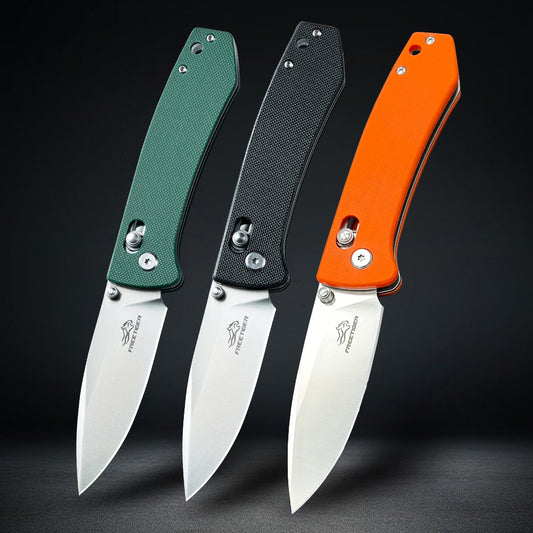
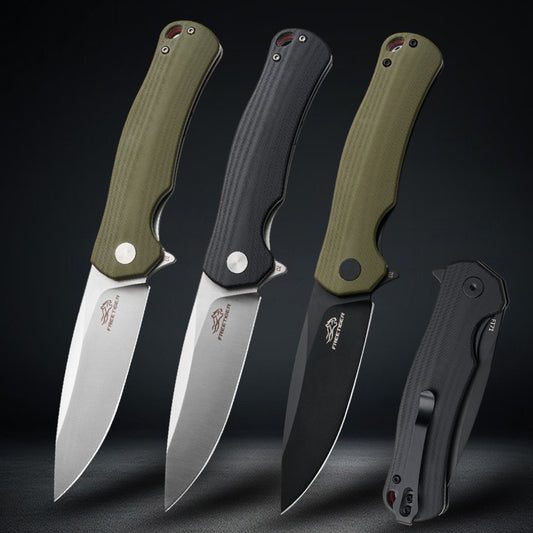
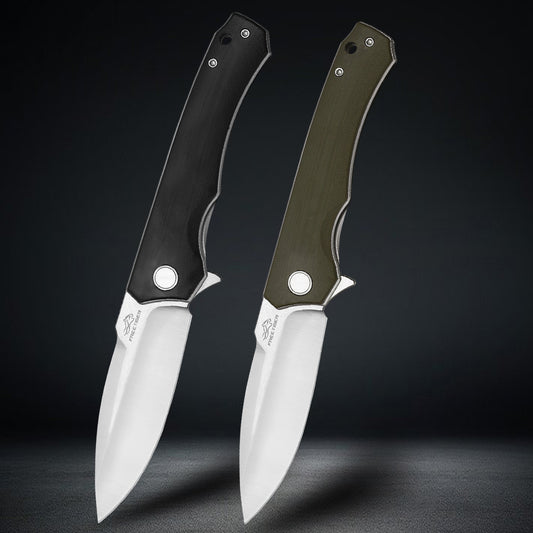
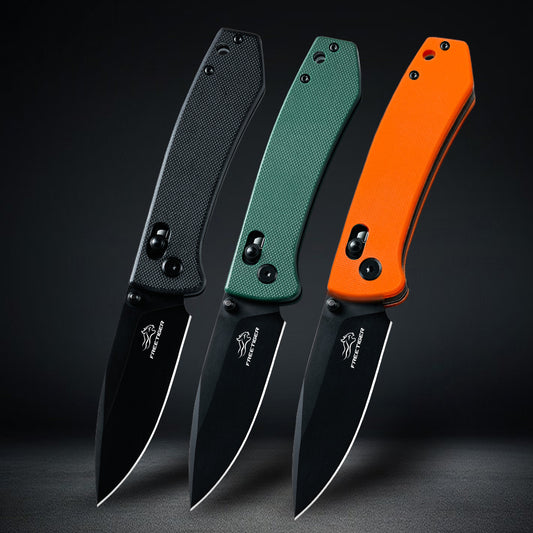
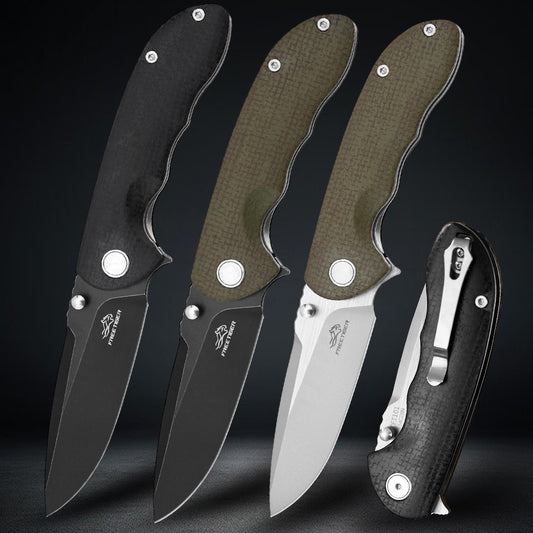
G10 vs Micarta – Which Handle Material Is Right for Your Knife?
Two Materials, Two Philosophies
If you’ve spent any time shopping for a quality folding knife, you’ve probably noticed that two handle materials keep appearing at the top of the list: G10 and Micarta.
At first glance, they look similar. Both are composite laminates. Both are tough, lightweight, and far more durable than wood or bone. But once you use them, the differences become clear.
This guide breaks down exactly what G10 and Micarta are, how they perform in real-world conditions, and—most importantly—which one fits your needs.

What Is G10?
G10 is a high-pressure fiberglass laminate. It’s made by layering sheets of fiberglass cloth, soaking them in epoxy resin, and compressing them under heat and pressure until they cure. The result is a material that’s incredibly rigid, lightweight, and nearly indestructible.
Originally developed for the aerospace and electronics industries—where material failure isn’t an option—G10 found its way into knife handles because it could take anything users could dish out. It is one of the most durable knife handle materials available.
Where G10 Excels
Exceptional Durability. G10 won’t crack, chip, warp, or deteriorate from moisture, chemicals, or UV exposure. It’s essentially impervious to everything short of a grinder. This makes it a superior choice for knives designed to last a lifetime.
Consistent Grip. The texture on G10 is machined in and stays put. Whether your hands are wet, oily, or covered in fish slime, a properly textured G10 handle maintains its grip characteristics. Testing shows G10 retains 92–95% of its dry friction coefficient when saturated with water.
Zero Maintenance. G10 asks nothing from you. No oiling, no conditioning, no special care. Rinse it off, wipe it down, forget about it.
Color Variety. G10 can be made in virtually any color, including layered multicolor options that look great when contoured. The color goes all the way through, so scratches don’t reveal different layers unless that’s intentional.
Where G10 Has Limitations
The Feel Factor. G10 feels synthetic because it is synthetic. Some users find it cold and lifeless compared to natural materials. For people who want an emotional connection with their tools, G10 doesn’t deliver.
Aggressive on Pockets. Heavily textured G10 can chew through thin pocket linings over time. The grip that works so well in hand can be rough on clothing.
Slippery When Smooth. Polished or smooth G10 can be surprisingly slick, especially with wet hands. It needs texture to really grip.

What Is Micarta?
Micarta is one of the original composite materials. It was developed in 1910 by George Westinghouse as an electrical insulator and has been used in knife handles since the 1940s.
Instead of fiberglass, Micarta uses organic fabrics—typically canvas, linen, paper, or burlap—soaked in phenolic resin and compressed under heat and pressure. The result is a tough material that feels warmer and more organic than G10. (Note: “Micarta” is technically a trademark held by Norplex Inc., but it’s commonly used as a generic term for this type of composite.)
Where Micarta Excels
Warmth and Character. Micarta feels organic in the hand—more like wood or natural material than plastic. Unlike G10, it develops a patina with use. The surface polishes and darkens in high-contact areas, creating a unique look that’s personal to the owner. Worn Micarta often looks better than new Micarta.
Superior Wet Grip. This is Micarta’s defining advantage. Many users report that Micarta actually becomes grippier when wet. The canvas or linen fibers can swell slightly with moisture, increasing surface friction. In wet conditions, Micarta often outperforms G10. One maker noted that Micarta’s grip-when-wet characteristic is real and not marketing hype.
Pocket Friendly. Micarta is gentler on pockets than textured G10. The surface provides enough grip for secure handling without being abrasive against fabric.
Shock Absorption. Micarta has a slight give that G10 lacks, providing subtle shock absorption during heavy use. It’s a small difference, but noticeable during extended cutting or chopping.
Where Micarta Has Trade-offs
More Maintenance. Depending on the specific formulation, some Micarta can absorb moisture, oils, and odors. Canvas Micarta is particularly prone to this. While rarely a structural issue, it can lead to staining and requires more attention than G10.
Less Consistent. Micarta’s grip characteristics change as it wears and polishes. What starts as a grippy surface might become smoother over years of use. Some users love this evolution; others prefer consistency.
Softer Surface. Micarta is less hard than G10 and can show wear—scratches, polishing, and surface marks—more readily. It also tends to be slightly heavier.

Head-to-Head Comparison

Performance in Specific Conditions
Wet Weather and Marine Environments
Testing shows G10 retains 92-95% of dry grip when wet, making it the top performer in quantitative tests. However, many users report that canvas Micarta actually gets grippier when wet because the exposed fibers create additional traction. Both are non-porous and won’t warp or swell with moisture exposure.
Winner: G10 for measured retention; Micarta for perceived wet grip
Temperature Extremes
G10 maintains dimensional stability from -40°F to 250°F continuous exposure, making it suitable for arctic and desert conditions. Micarta performs well from -30°F to 200°F. Both significantly outperform wood, which faces cracking risks with rapid temperature changes.
Winner: G10
Chemical Exposure
G10 is essentially chemically inert. Micarta resists most chemicals but can be affected by prolonged exposure to certain solvents.
Winner: G10
Which One Should You Choose?
Choose G10 If:
- You want maximum durability and zero maintenance
- The knife will see marine, chemical, or harsh environments
- You prefer bright colors or consistent appearance
- You want tactical or rescue-use performance
- You prioritize function over feel
Best for: EDC, tactical use, marine environments, hard-use work knives
Choose Micarta If:
- You value traditional aesthetics and warm feel
- You want a handle that develops character and personality
- Pocket carry comfort matters (gentler on clothes)
- You prefer natural grip characteristics, especially when wet
- You’re building or buying an heirloom piece
Best for: Hunting, bushcraft, outdoor work, collector’s knives
Real-World Recommendations from Makers
According to one knife maker who’s built countless knives with both materials:
“G10 is the material we trust most. It machines predictably, holds hardware well, and we’ve never had a warranty claim related to handle failure on G10 scales.”
But they also noted:
“If the tactile experience of your knife matters to you. If you appreciate tools that age with use. If you regularly use your knife in wet conditions. If you want something that feels a step above G10 without jumping to titanium prices—Micarta is the answer.”
Another maker put it simply: G10 is “a true ‘set it and forget it’ material,” while Micarta offers “a more organic experience that develops personality”.

Frequently Asked Questions (FAQ)
Is G10 or Micarta better for wet weather?
G10 retains 92-95% of dry grip when wet, making it the top performer in quantitative tests. However, canvas Micarta is often preferred outdoors because the exposed fibers create additional traction when wet. Both are non-porous, so neither warps or swells with moisture exposure.
Which handle material lasts longer?
G10 is virtually indestructible in normal use. Micarta can show wear over time—scratches, surface marks, and polishing in high-contact areas—though it remains extremely durable.
Does Micarta absorb water?
Depending on the specific formulation, some Micarta can absorb surface moisture, oils, and odors. Canvas Micarta is particularly prone to this. While rarely a structural issue, it can lead to staining and require more attention than G10.
Which is more expensive?
Micarta is generally more expensive than G10, partly because it’s more labor-intensive to finish and requires hand labor. G10 costs about 30-40% less than Micarta.
Which material feels better in hand?
Micarta feels warmer and more organic, like wood or natural material. G10 feels synthetic and can feel cold to some users. This is subjective—some prefer the technical feel of G10, others the natural warmth of Micarta.
The Bottom Line
Both G10 and Micarta are excellent handle materials that outperform traditional options like wood or bone. The choice comes down to your priorities.
If you want a bombproof, no-maintenance workhorse that performs consistently in any condition, G10 is the answer.
If you want a handle that feels warm, develops character, and connects you to the tool—especially if you’re using it outdoors in wet conditions—Micarta is hard to beat.
Neither choice is wrong. Both will serve you well for years or even decades. The best material is the one that fits your hand and your use case.